Varanasi: Why this “Eternal City” changes people
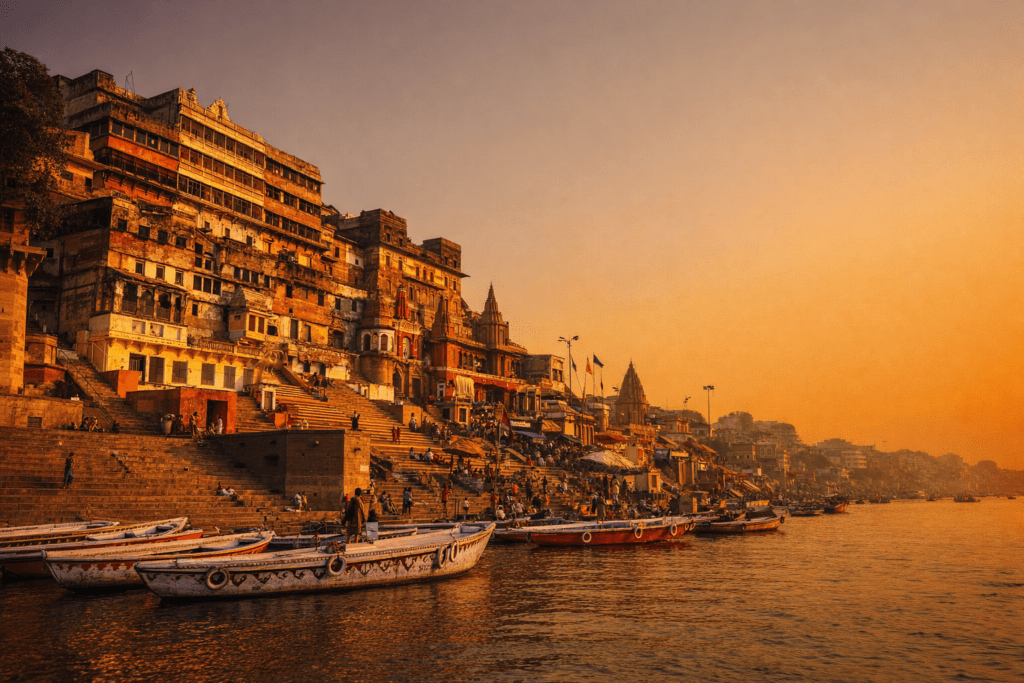
Varanasi also called Kashi or Banaras is one of the world’s oldest continuously inhabited cities, anchored on the sacred Ganges (Ganga) and central to Hindu pilgrimage, death rituals, and spiritual liberation.
It’s not a city you “tour” in the usual sense. It’s a city you feel where life and death share the same skyline, and the idea of moksha (liberation) is not philosophy but lived reality.
As a post graduate professional working in senior management at a Big 4 firm, I’ll keep this blog structured, practical, and search intent-first: you’ll walk away with a Varanasi visit plan you can execute.
The spiritual core: Kashi Pilgrimage & Moksha/Liberation
1) Kashi Vishwanath Temple (Golden Temple)
The Kashi Vishwanath Temple is one of Hinduism’s most revered Shiva temples and one of the 12 Jyotirlinga shrines, making it central to any Kashi pilgrimage.
For planning, the official trust portal is useful for darshan services and updates.
The sacred river: Ganges, Ghats & what to do (and feel)
2) Ganga Aarti (Dashashwamedh Ghat)
Dashashwamedh Ghat is among Varanasi’s most prominent ghats and is world famous for the evening Ganga Aarti a synchronized ritual of lamps, bells, incense, and chants.
This is often the emotional highlight of a first visit your “welcome ceremony” into the Sacred Ganges and the city’s living traditions.
Planning tip: Arrive early and decide whether you want to watch from the steps or from a boat (boat offers a panoramic view and avoids heavy crowd compression).
3) Sunrise Boat Ride (essential experience)
A sunrise boat ride is the most efficient way to understand the ghats as a continuous spiritual theatre—chants, bathing rituals, temple bells, and the city waking up. (This is also where the “Eternal City” feels most real.)
4) Manikarnika Ghat (cremation ghat), the city’s truth serum
Manikarnika Ghat is one of Hinduism’s holiest cremation grounds; belief holds that cremation here can grant moksha, breaking the cycle of rebirth.
This is not “tourism”, it’s a sacred space. If you go, go with humility.
5) Assi Ghat (calmer, reflective, cultural)
Assi Ghat is the southernmost ghat and is widely known as a place where long term foreign travelers and students gravitate—more spacious, calmer, and excellent for early mornings.
It also sits at the confluence of the Assi and Ganges rivers.
Sarnath: add a Buddhist dimension to your soul journey
6) Sarnath (Buddhist site)
Just outside Varanasi, Sarnath is where Buddha is believed to have delivered his first teaching, a cornerstone in Buddhist pilgrimage.
The Dhamek Stupa stands in Deer Park and is a major landmark associated with this event.
If your travel style includes “meaning”, Sarnath balances the intensity of the ghats with silence and reflection.
A practical Varanasi visit plan (2–3 days)
Day 1 — Arrival + Evening devotion
• Check in, rest, light walk around old city lanes (“Narrow Lanes of Varanasi” are part of the experience).
• Evening: Ganga Aarti at Dashashwamedh Ghat.
Day 2 — Sunrise + temples + life/death perspective
• Sunrise boat ride along the ghats.
• Visit Kashi Vishwanath Temple (ideally early to reduce crowd friction).
• Walk through select ghats; if visiting Manikarnika, observe respectfully and briefly.
Day 3 — Sarnath + cultural close
• Morning visit to Sarnath/Dhamek Stupa.
• Slow lunch, silk/handicraft browsing, and a quieter ghat like Assi to decompress.
“Transformational” celebrity visits (Hollywood) + citations
Varanasi’s pull isn’t limited to pilgrims. Multiple international celebrities have visited (or filmed) here often describing it as spiritually intense.
• Brad Pitt visited Varanasi and has publicly described it as “absolutely staggering… the city just spills into the river Ganges… extraordinary.”
• Reports also mention Hollywood cast members connected to “Eat, Pray, Love” visiting Varanasi (as covered via an ANI-syndicated report).
Do’s & Don’ts for foreign travelers (especially around rituals)
Do
• Dress modestly at temples/ghats (covered shoulders/legs is a safe baseline).
• Keep cash for small payments/tips and boat rides.
• Use a guide for old city lanes and ritual context, Varanasi is dense and easy to misread on day one.
• At Manikarnika Ghat, maintain silence and distance; treat it like a sacred funeral space.
Don’t
• No photography at cremation areas, this is repeatedly highlighted as a strict respect rule in visitor etiquette guidance.
• Don’t block pathways during aarti/rituals; crowds move in pulses.
• Don’t treat sadhus or rituals as “props” for social media—ask permission where appropriate.
Where to stay: hotel choices by travel style
Luxury / Heritage (experience-led)
• Taj Nadesar Palace (heritage palace property; positioned as a luxury retreat close to the Ganges). [tajhotels.com]
• BrijRama Palace (heritage hotel on the banks near Darbhanga Ghat; positioned as a historic palace stay). [brijhotels.com]
Nearest airport & train station (so you can plan like a pro)
• Nearest airport: Lal Bahadur Shastri International Airport (VNS) is the key airport for Varanasi.
• Nearest major railway station: Varanasi Junction (BSB) is the main railhead used by most travelers.
How Sahajdarshan can help (especially for foreign travelers)
Varanasi is beautiful but operationally complex: narrow lanes, vehicle restrictions near ghats, crowd timing around aarti, and culturally sensitive spaces like Manikarnika. The easiest way to reduce friction is to outsource logistics so you can focus on the soul journey.
Sahajdarshan can support with:
• End to end itinerary design (2–4 day plans including Kashi Vishwanath, ghats, Sarnath, and optional cultural add ons).
• Airport/train station pickups, trusted drivers, and time boxed movement plans.
• Ritual safe experiences: sunrise boat ride, best angle Ganga Aarti viewing, guidance on where photography is appropriate (and where it isn’t).
• Foreign traveler comfort: language support, transparent pricing guidance, hotel shortlisting, and cultural etiquette briefings before key experiences.
Benefits for foreign travelers: fewer scams, less confusion in old lanes, better timing for aarti/temple visits, and respectful navigation of sacred spaces—without feeling rushed or unsafe.
Varanasi doesn’t give you a perfect itinerary, it gives you a mirror. When you plan well, the city’s intensity becomes clarity.
Har Har Mahadev !
https://sahajdarshan.com/temples/kashi-vishwanath