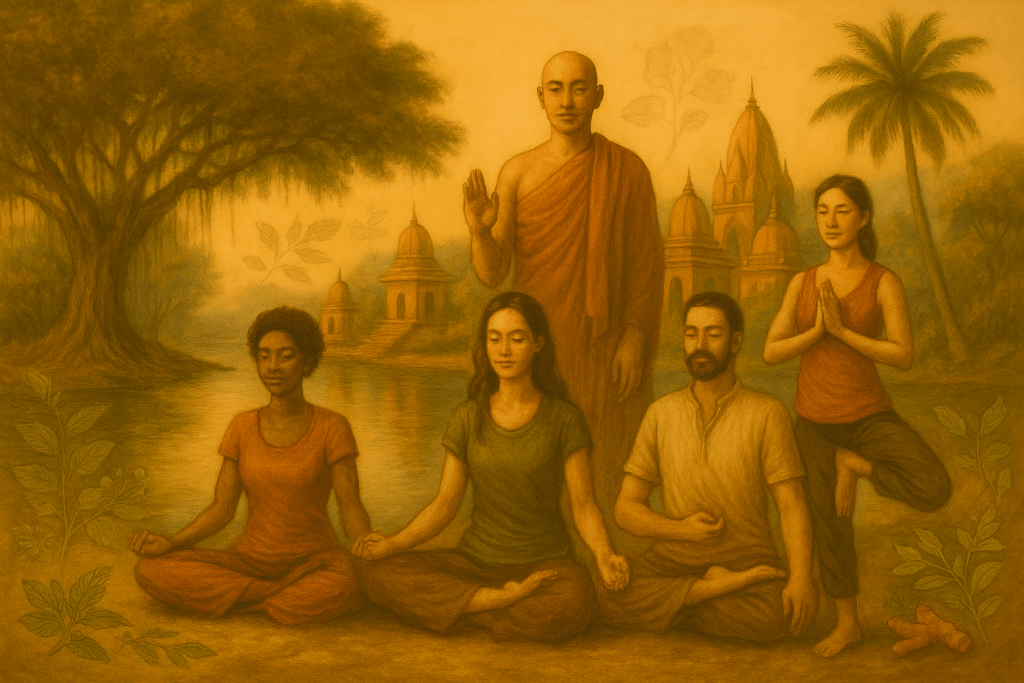
India isn’t just a place you visit, it is a place that visits you back. For countless Western travelers, the subcontinent becomes the crucible for a transformative journey: early-morning sun salutations by the Ganges, days of mindful silence in Himalayan meditation camps, and Ayurvedic therapies that reset the body from the inside out. If you’re a seeker searching for peace, clarity, or the true purpose of life, India offers spiritual experiences that are immersive, accessible, and profoundly human.
Why India? The Source and the Setting
- Rishikesh: Yoga Capital of the World. On the banks of the Ganges beneath the Himalayan foothills, Rishikesh earned its global reputation thanks to centuries of practice, institutions, and cultural momentum (and yes, a little help from The Beatles). It remains a top destination for yoga retreats and teacher trainings grounded in tradition.
- Dharamshala: Meditation in the mountains. Known for Tibetan Buddhist influence and serene monasteries, Dharamshala offers structured meditation programs from introductory courses to intensive retreats set in crisp mountain air and contemplative spaces.
- Kerala: Ayurveda’s lush cradle. Kerala’s regulated wellness ecosystem and experienced Vaidyas (Ayurvedic physicians) make it ideal for authentic Panchakarma detox and rejuvenation, ranging from beachside clinics to heritage palaces.
Icons & India: How a Country Shaped Global Creators
India’s spiritual gravity has pulled in some of the world’s most recognized names, each with a story of introspection and renewal:
- Steve Jobs traveled to Kainchi Dham (Neem Karoli Baba’s ashram) in the 1970s, spending months roaming and reflecting in India. Archival letters and reportage show how that period sharpened his focus on simplicity and intuition values he later translated into product design and leadership.
- Mark Zuckerberg later shared that Jobs encouraged him to visit the same ashram during Facebook’s early, uncertain days seeking clarity and reaffirmation of mission.
- The Beatles went to Rishikesh in 1968 to study Transcendental Meditation with Maharishi Mahesh Yogi; the visit shaped Western attitudes toward Indian spirituality and seeded a remarkably creative phase in their songwriting.
- Julia Roberts has spoken publicly about being a practicing Hindu, describing how seeing a photo of Neem Karoli Baba drew her deeper into the path recounted in interviews and features.
- Chris Martin (with Dakota Johnson) recently immersed in India’s spiritual culture while touring visiting temples in Mumbai and speaking to audiences with gratitude and humility.
The Seeker’s Three Paths: Yoga, Meditation, Ayurveda
1) Yoga Retreats: Moving Toward Stillness
In India, yoga is less a fitness regime and more a philosophical technology for self-understanding. In Rishikesh, retreats weave asana, pranayama, mantra, and karma yoga (service) into daily schedules. Expect simple accommodations, sattvic (clean, vegetarian) meals, and riverbank practices at dawn.
- Where to start: Parmarth Niketan (large ashram, public Ganga Aarti), boutique schools with 200/300-hour trainings, and riverside centers offering restorative intensives.
- Why Rishikesh works: centuries old tradition, abundant teachers, and an environment that supports mindful living beyond the mat.
2) Meditation Camps: Rewiring Attention
Meditation retreats vary from secular Vipassana to Tibetan Mahayana frameworks:
- Vipassana at Igatpuri (near Mumbai). The world-renowned 10-day silent course at Dhamma Giri trains you to observe breath and body sensations, cultivating equanimity. It’s rigorous, donation-based, and life-changing for many.
- Tibetan Buddhist courses in Dharamshala. Introductory and advanced programs at Tushita Meditation Centre blend teachings, practice, and community, with a backdrop of cedar forests and Buddhist culture.
What you’ll gain: meta-awareness, resilience under stress, and a quieter mind. What you’ll surrender: phones (often), snacks (sometimes), and the illusion that multitasking equals meaning.
3) Ayurveda in Kerala: Healing the Whole
Ayurveda sees health as harmony of body, mind, and environment. The gold standard Panchakarma (five actions) protocol customized by an Ayurvedic doctor may include Vamana (therapeutic emesis), Virechana (purgation), Basti (medicated enemas), Nasya (nasal therapy), and occasionally Raktamokshana (bloodletting), supported by daily Abhyanga (oil massage), Shirodhara, herbal preparations, and a light, medicinal diet.
- Authentic centers to research: Somatheeram (Kovalam), Kalari Kovilakom & Kairali (Palakkad), Nattika Beach Ayurveda Resort (Thrissur), Ayursoma (Trivandrum), and boutique doctor-led sanctuaries.
- How to choose: verify medical oversight, treatment plans, and government registration (AYUSH); match duration (typically 10–21 days) to your goals.
Some notable personalities experiences in India in their words have been as follows
- Steve Jobs (on India’s impact): India stripped away the non-essential; I came back different leaning into simplicity and intuition.
→ Originals & coverage: Business Today’s feature on the 1974 letter; Hindu Press International’s roundup of the auction and context. - Mark Zuckerberg (on Kainchi Dham): On Jobs’s advice, I visited Neem Karoli Baba’s ashram during a challenging time; it helped me clarify Facebook’s purpose.
→ Coverage: Times of India tech desk explainer on the visit. - The Beatles (on Rishikesh & TM): Rishikesh offered respite and discipline; meditation sessions coincided with a creative surge that reshaped our music.
→ Background & museum articles: Wikipedia overview; The Beatles Story (Liverpool) on TM’s impact. - Julia Roberts (on Hindu practice): I’ve practiced Hinduism for years; a photo of Neem Karoli Baba was a quiet, powerful catalyst.
→ Interview references: Times Now summary; Economic Times feature citing her ABC interview. - Chris Martin (gratitude in Mumbai): Thank you for welcoming us; acknowledging history, we feel humbled to be here.
→ News coverage: The Independent, USA Today, Billboard Canada. - Dakota Johnson (temple visits): Participating in local rituals offered a grounded, spiritual experience alongside the tour.
→ Reports & footage: Daily Mail; India Today; NDTV Entertainment.
How to Plan Your Transformative Journey
1) Clarify your intent (the seeker’s compass).
Are you pursuing stress relief, creative renewal, or searching for the true purpose of life? Your aim will determine whether you pick a silent meditation camp, a yoga immersion, or a medical-grade Ayurvedic program.
2) Choose your season.
October to March brings cooler, pleasant weather for the north (Rishikesh, Dharamshala); Kerala is year round but many prefer November–February for mild temperatures during Panchakarma. (please check each center’s schedule pages.)
3) Select your program (verify authenticity).
- Vipassana (Igatpuri): 10-day course, noble silence, donation-based; strict discipline and daily schedule published by the organization.
- Tibetan Buddhist study (Dharamshala): structured introductory and advanced courses at Tushita.
- Ayurveda (Kerala): doctor-led diagnosis, monitored therapies, government regulation mentions (AYUSH). Shortlists and detailed guides are helpful starting points.
4) Prepare your body & mind.
Reduce caffeine/alcohol, clean up your diet (sattvic basics), start gentle asana and basic breathwork (e.g., Anulom Vilom). Expect minimal phone use and simple living—comfort is present, but distraction isn’t the point.
5) Respect local culture.
Dress modestly, learn a few greetings, and participate sincerely in rituals like Ganga Aarti with attention and reverence. Service (seva) often becomes the heart of the experience.
Practical Tips for Western Travelers
- Visas & logistics: e-Visas are standard; book retreats well in advance (popular programs fill quickly). Course schedules and application links are published online follow center instructions precisely.
- Costs & donations: Vipassana courses are by donation; Ayurveda pricing varies widely with accommodation and protocol complexity compare centers with detailed guides before committing.
- Health & safety: Bring medications, adhere to retreat diets, and tell doctors about allergies or conditions. In Panchakarma, follow post-treatment diet/lifestyle guidance for best results.
Closing Reflection: The Journey Meets You Where You Are
For many Westerners, India catalyzes a shift from doing to being, from noise to nuance. Whether you’re unrolling your mat in Rishikesh, descending into silence at Igatpuri, or surrendering to warm oil and herbal therapies in Kerala, you’re stepping into a lineage that’s both ancient and astonishingly relevant. The path won’t hand you answers; it shows you how to listen. And that listening patient, compassionate, inward is often where seekers discover their true purpose of life.
https://sahajdarshan.com/blog/faq-for-foreign-tourists
To know more and get help in planning your itinerary, connect with us at https://sahajdarshan.com/auth/signup